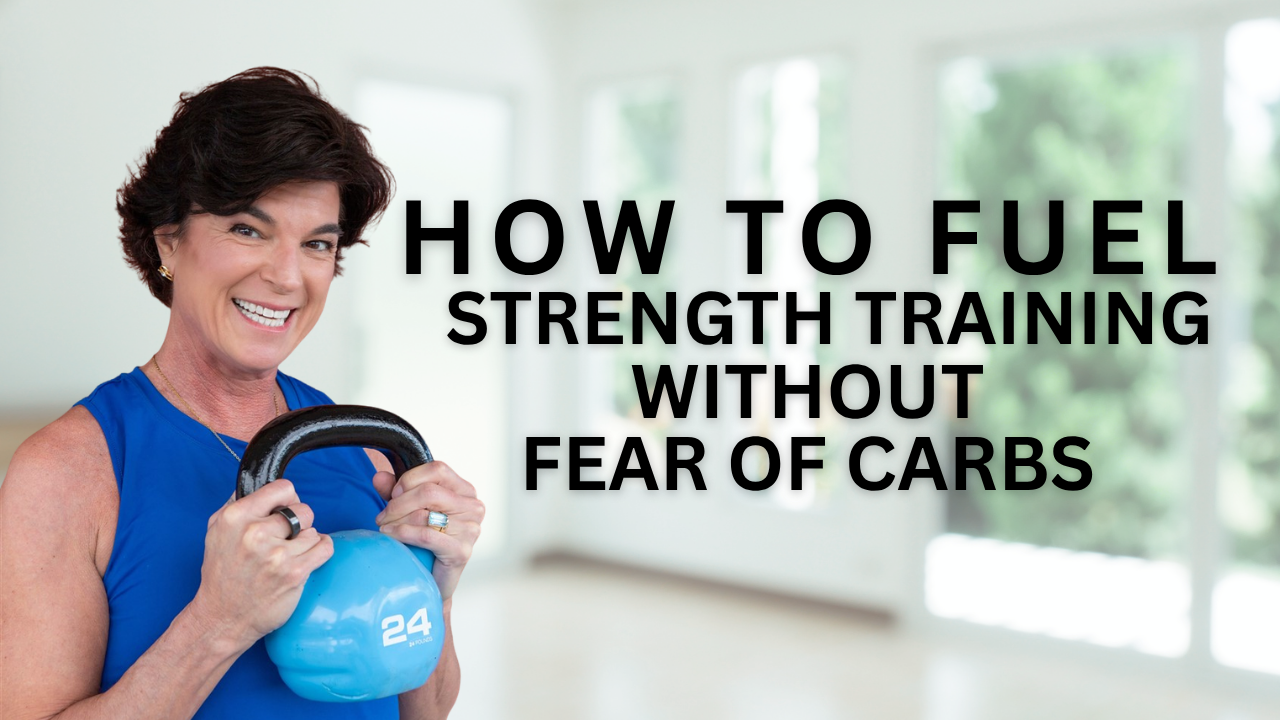
How to Fuel Strength Training Without Fear of Carbohydrates
Apple Podcast - Spotify - YouTube
If you’re a woman over 40, you may be wondering what to eat before and after strength training—especially if your goals include building muscle, losing stubborn belly fat, and having more energy.
There is so much conflicting information out there. Exercise fasted. Never exercise fasted. Avoid carbohydrates. Eat carbohydrates. Drink a protein shake immediately. Wait until your next meal. It’s enough to make you wonder if you need a nutrition degree just to complete your workout!
I want to simplify this for you.
Your midlife body needs adequate fuel to perform, recover, and build lasting muscle. That doesn’t mean you need a huge meal every time you pick up a dumbbell, but intense exercise during perimenopause, menopause, and post-menopause usually deserves more support than a cup of coffee and sheer determination.
Why Strength Training After 40 Requires Proper Fuel
Strength training sends an important message to your body.
When you challe...
3 Protein Mistakes That Keep Women From Losing Weight
Apple Podcast - Spotify - YouTube
This post contains affiliate links, which means I may earn a small commission at no extra cost to you.
If you've been faithfully eating healthy, following Trim Healthy principles, and still wondering why the scale isn't moving, I want to encourage you today. It may not be because you're eating too many carbs. It may not be because your metabolism is "broken." And it may not even be because your hormones are working against you.
One of the most overlooked reasons women struggle to lose weight during perimenopause and menopause is simply not getting enough protein—or not eating it in the right way. I know because I've walked this road myself. As a certified personal trainer, menopause fitness specialist, and Trim Healthy Mama coach, I've watched hundreds of women make this one change and begin noticing fewer cravings, better energy, improved strength, and more success losing body fat without feeling deprived.
Today I want to share the three bi...
5 Strength Training Myths Keeping Women Over 40 Stuck
Apple Podcast - Spotify - YouTube
Have you ever found yourself wondering if you're doing the right workout?
Maybe you've questioned whether you're lifting heavy enough, exercising long enough, or following the best strength training program to lose weight. If so, you're not alone.
One of the biggest struggles I see among women in perimenopause and menopause isn't a lack of effort. It's confusion. Many women are working hard but still feel stuck because they've been following beliefs about exercise that simply aren't true.
The good news?
A major new research review from the American College of Sports Medicine confirms something I've been teaching for years as a personal trainer, menopause fitness specialist, and Trim Healthy Mama coach: strength training after 40 doesn't have to be complicated.
In fact, some of the beliefs keeping women stuck are actually preventing them from seeing results.
Let's talk about five of the biggest strength training myths and what the latest re...
Can You Lose Weight Walking After 40? Here’s the Truth
Apple Podcast - Spotify - YouTube
There is absolutely a place for walking in midlife.
I walk almost every single day. I love it for stress relief, energy, fresh air, blood sugar support, and simply getting my body moving. Walking matters. Yoga matters. Pilates matters. Rebounding matters.
But if you are trying to lose belly fat after 40 and your body composition is not changing the way you hoped, there may be a missing piece.
And for many women, that missing piece is strength training.
So many women tell me, “Kris, I’m moving my body. I’m trying. I’m doing the things. Why isn’t my body changing?”
That question matters because your body is communicating with you.
In this season of perimenopause and menopause, the strategy that worked in your 20s and 30s often stops working the same way. Your body is asking for a new approach.
If your goal is strength training to lose weight, support hormones, improve metabolism, and age well, this conversation is important.
Why Midl...
3 Protein Mistakes That Keep You Stuck After 40
Apple Podcast - Spotify - YouTube
If you’ve been doing your best to eat healthy, follow Trim Healthy principles, and still feel stuck… I want you to lean in here.
Because when it comes to protein for weight loss, this might be the very thing that’s been missing all along.
You’re not eating worse.
You’re not moving less.
But your body is different now.
And if you’ve been wondering how to lose lower belly fat in this season, the answer is often much simpler—and more foundational—than you think.
Let’s talk about the three protein mistakes I see over and over again with midlife women… and how to gently shift them so your body can finally start responding again.
Why Protein for Weight Loss Matters More After 40
Midlife changes things. That’s just the truth.
Your hormones are shifting, your metabolism feels slower, and your body doesn’t respond the way it used to. What worked in your 20s and 30s just doesn’t land the same anymore.
One of the biggest reasons? Something cal...
Want Better Results When You Strength Train? Fix This First
Apple Podcast - Spotify - YouTube
This post contains affiliate links, which means I may earn a small commission at no extra cost to you.
Have you ever walked into a workout feeling tired, shaky, or just not quite yourself… and wondered what’s going on?
You’re trying to lose weight with a high protein approach.
You’re showing up.
You’re doing the workouts.
And yet—your energy feels off, your results feel slow, and sometimes you leave your workout feeling worse than when you started.
This is something I see all the time with women in midlife.
And it’s not because you’re doing something wrong.
It’s because your body is asking for something different.
One of the biggest pieces we have to understand is this:
How you fuel your body before your workout matters more after 40 than it ever did before.
High Cortisol and Midlife Workouts: What’s Really Happening
Let’s talk about something that doesn’t get enough attention.
High cortisol.
You may have heard that word and wondere...
The Protein Pitfall Stalling Your Fat Loss After 40
Apple Podcast - Spotify - YouTube
Friend, if you feel like you’re doing all the right things—eating healthy, trying to stay on plan, maybe even moving more—but your body just isn’t responding… I want you to pause right here with me.
Because this might not be about trying harder.
It might be about understanding how your body has changed—and what it actually needs now.
Today we’re talking about protein, strength training, and even how high cortisol can quietly play a role in why things feel stalled. We’re also going to answer a question I hear all the time: how much protein do you really need to lose weight with a high protein approach in midlife?
And friend, the answer might surprise you.
The Protein Rule You’ve Been Following Might Be Outdated
For years, we were taught that your body can only absorb 20–30 grams of protein at a time.
Anything more?
Wasted.
Or worse—stored as fat.
So many women I work with are still building their meals around that belief. They’re gettin...
What’s The Truth About Creatine for Midlife Women?
Apple Podcast - Spotify - YouTube
Have you ever wondered if there’s something simple that could actually help you strength train, lose weight high protein, and protect your midlife brain — without turning you into a bodybuilder or making the scale jump overnight?
Let’s talk about creatine.
I know. Some of you immediately think, “Isn’t that for guys in tank tops at the gym?” That misunderstanding has kept a lot of good women from one of the most researched and supportive supplements available — especially for women in perimenopause and menopause.
As a Trim Healthy coach, personal trainer, and menopause fitness specialist, I don’t recommend supplements lightly. I believe in Protein, Plants, and Power. I believe in strength training. I believe in blood sugar balance. But creatine is one of the few supplements that truly earns its place on the shelf for midlife women.
Let’s calmly and clearly walk through the truth.
What Creatine Actually Is (And Why It Matters When You Stre...
5 Reasons Strength Training Isn’t Helping You Lose Weight
Apple Podcast - Spotify - YouTube
You’re strength training. You’re trying to lose weight. You’re even adding what you think is the right kind of fat burn exercise for belly fat. And yet… the scale barely moves. Your midsection still feels softer than you’d like. Your arms aren’t leaning out the way you expected.
If you’re a Christian midlife woman navigating perimenopause or menopause and following Trim Healthy principles, this can feel incredibly frustrating. Especially when you know you’re “doing the right things.”
But here’s what I want you to hear first: sometimes the issue isn’t that you’re not working hard enough. Sometimes the issue is what’s happening inside your muscle.
As a Trim Healthy coach, personal trainer, and menopause fitness specialist, I’ve learned that midlife fat loss isn’t just about building muscle. It’s about building clean, metabolically healthy muscle. And that’s a different conversation than most women have ever been taught.
Let’s walk through ...
Why Midlife Weight Loss Has To Be Simple Now
Apple Podcast - Spotify - YouTube
If you’re in midlife and feel like weight loss has suddenly become complicated, frustrating, or downright confusing, I want you to pause right here and take a breath.
Because the truth is this: midlife weight loss doesn’t need to be harder—it needs to be simpler.
I see so many women in their 40s, 50s, and early 60s who are doing “everything right.” They’re eating real food. They’re following Trim Healthy principles. They’re staying active. And yet the scale won’t move, belly fat feels more stubborn than ever, energy is lower, and confidence starts to wobble.
This isn’t because you’re failing.
It’s because your body has entered a new physiological season—and that season demands a simpler, more supportive approach.
Midlife Is a New Season, Not a Setback
Menopause is not just a phase you power through. It’s a hormonal transition that changes how your body stores fat, builds muscle, regulates blood sugar, and responds to stress.
Think a...
Ready for more real talk, fat loss tips, and hormone support made for midlife women?
Author

Kris Honeycutt
I’m a Trim Healthy executive coach, menopause fitness specialist, and personal trainer helping women over 40 lose stubborn weight, balance hormones, and feel confident in midlife bodies. Around here, we ditch diet drama and build real results—one wise, grace-filled step at a time.
Recent Posts

Join my Tribe today
How do you make Trim Healthy your lifestyle eating plan?
By getting community & coaching support.
Real change happens with accountability and habits. You get both inside Get Your Trim On Tribe Membership.
Get Your Trim On Store
Products that I have created to help you be successful in your Trim Healthy Mama journey.
What does Coach Kris buy from the THM store?
I am an official THM store affiliate and may earn a commission from purchases made through this link.
Baobab - Optimized Plant Protein - Optimized Whey Protein - Essential Amino Acids - No Carb Easy Bread
