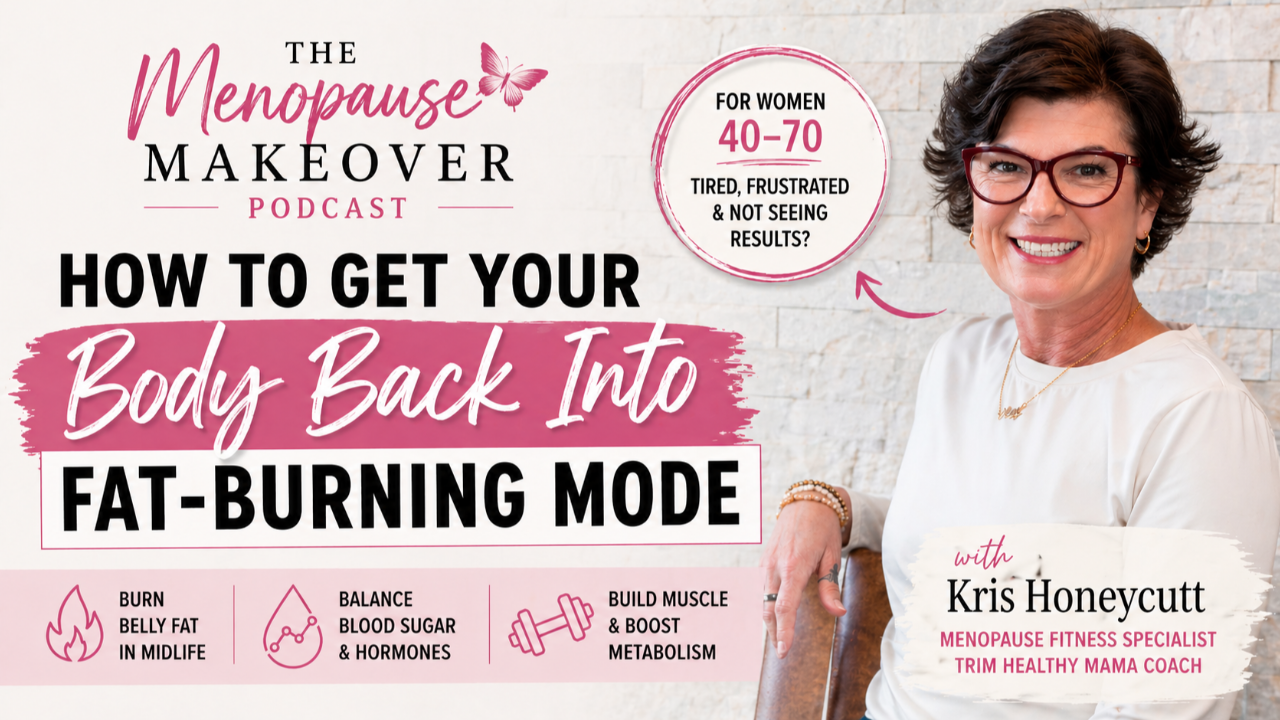
How to Get Your Body Back Into Fat-Burning Mode
Apple Podcast - Spotify - YouTube
Have you ever felt like your body just… stopped responding?
You’re doing what worked before.
You cleaned up your eating. You’re staying consistent. You’re working out. You’re trying to burn belly fat the way you always have.
And yet… your body is not cooperating.
The scale is stuck. Your energy is low. And somehow, belly fat feels like it’s showing up faster than ever.
If you’ve found yourself wondering, “Why is my body not in fat-burning mode anymore?”—you’re not alone, and you’re not imagining it.
This is one of the biggest shifts that happens in midlife.
Why Belly Fat Burning Changes After 40
Here’s what I want you to understand first, your body is not working against you.
It’s responding to a new season.
As we move through perimenopause and menopause, hormones begin to shift in ways that affect everything—your metabolism, your energy, your muscle, and how your body stores fat.
One of the biggest drivers behind this change is high cortisol.
When cortisol levels stay elevated—whether from stress, under-eating, over-exercising, or lack of sleep—your body shifts out of fat-burning mode and into protection mode.
And that protection often shows up as belly fat.
High Cortisol and Belly Fat: What’s Really Happening
Your body is always asking one question: Am I safe?
When your body senses stress—physical or emotional—it prioritizes survival over fat loss.
That means:
- Fat burning slows down
- Belly fat storage increases
- Energy drops
- Cravings go up
So if you’ve been trying to push harder, eat less, or do more cardio… it can actually keep cortisol high and make fat loss feel harder.
This is where so many women get stuck.
Not because they’re doing nothing—but because they’re doing what used to work in a completely different season.
Why “Eat Less and Move More” Stops Working
This is one of the biggest mindset shifts we have to make.
For years, we were told:
- Eat less
- Move more
- Burn more calories
But in midlife, that approach can backfire.
Chronic under-eating slows your metabolism over time. Your body adapts by becoming more efficient, meaning it burns fewer calories and holds onto fat more tightly.
At the same time, if strength training is missing, muscle loss accelerates.
And muscle is what drives fat burning.
So now you have:
- Less muscle
- Slower metabolism
- Higher cortisol
And suddenly, belly fat burning feels almost impossible.
Insulin Resistance and Blood Sugar Imbalance
There’s another piece of the puzzle that we can’t ignore—insulin resistance.
As estrogen declines, your body becomes more sensitive to blood sugar swings.
When meals are low in protein or unbalanced, blood sugar rises quickly.
And when blood sugar spikes, your body stores fat more easily—especially in the midsection.
That’s why learning how to keep your blood sugar levels more normal is one of the most powerful shifts you can make.
This is also why the Trim Healthy approach works so well in midlife.
How to Get Your Body Back Into Fat-Burning Mode
Now let’s talk about what actually works.
Not extremes. Not punishment. Not starting over every Monday.
But simple, strategic shifts that support your body in this season.
1. Prioritize Protein at Every Meal
Protein is one of the most powerful tools for fat loss in midlife.
It helps:
- Stabilize blood sugar
- Reduce cravings
- Preserve muscle
- Support hormone balance
Aim for 25–35 grams of protein at each meal.
This is one of the foundational principles of Trim Healthy, and it’s especially important now.
When your meals are anchored in protein, your body feels safe enough to start releasing fat again.
2. Balance Your Meals to Support Blood Sugar
This is where we move away from extremes and into balance.
You don’t need to cut out carbs or fear fats.
Instead, we learn to use protein, carbs, and fats strategically so your body can function well.
Balanced meals help keep blood sugar steady, which helps reduce fat storage and supports belly fat burning.
This is the beauty of Trim Healthy—it gives you structure without restriction.
3. Shift From “Burn” to “Build”
This is a big one.
Instead of asking, “How can I burn more?”—start asking, “How can I build and support my body?”
Because building muscle is what turns your metabolism back on.
Strength training 2–3 times per week is one of the most effective ways to:
- Increase fat burning
- Improve insulin sensitivity
- Support hormone balance
Cardio has its place, but it’s not the main driver anymore.
4. Support Your Body to Lower High Cortisol
This might be the missing piece for you.
Lowering cortisol isn’t about removing all stress—that’s not realistic.
It’s about supporting your body through it.
That looks like:
- Eating enough (not under-eating)
- Prioritizing sleep
- Managing daily stress
- Not overtraining
When cortisol comes down, your body becomes more willing to release belly fat.
5. Pay Attention to Meal Timing
Grazing all day or skipping meals both create problems.
Your body needs rhythm.
Start your day with a solid, protein-rich breakfast.
Then allow time between meals so your body can burn through fuel before refueling again.
This helps your body move more efficiently between using food and using stored fat.
The Mindset Shift That Changes Everything
This part matters more than most people realize.
If your thoughts sound like:
- “Nothing is working”
- “I’m failing”
- “I should be further along”
That pressure creates more stress… which raises cortisol… which makes fat loss harder.
Instead, I want you to see this differently.
This is feedback.
Your body is not shutting down—it’s speaking.
And when you start listening instead of fighting it, everything begins to shift.
As Scripture reminds us in Romans 12:2, we are called to be transformed by the renewing of our mind.
That includes how we think about our bodies in this season.
You’re Not Stuck—You’re in a Shift
If you’ve been feeling frustrated, tired, or confused… take a breath.
Nothing is wrong with you—your body is simply asking for a new approach.
Midlife is not the time to push harder.
It’s the time to get smarter, more strategic, and more supportive of your body.
When you focus on:
- Protein
- Plants
- Power (strength training)
You begin to create the environment your body needs to come back into balance.
And from that place… fat burning follows.
This is not about perfection.
This is about learning how to work with your body instead of against it.
Small, consistent shifts will take you further than extremes ever could.
And if you’re ready to take this deeper, come join me inside my community where we walk this out together—step by step.
You don’t have to figure this out alone.
This is your season to rebuild, restore, and feel strong again.
Ready for more real talk, fat loss tips, and hormone support made for midlife women?
Author

Kris Honeycutt
I’m a Trim Healthy executive coach, menopause fitness specialist, and personal trainer helping women over 40 lose stubborn weight, balance hormones, and feel confident in midlife bodies. Around here, we ditch diet drama and build real results—one wise, grace-filled step at a time.
Recent Posts

Join my Tribe today
How do you make Trim Healthy your lifestyle eating plan?
By getting community & coaching support.
Real change happens with accountability and habits. You get both inside Get Your Trim On Tribe Membership.
Get Your Trim On Store
Products that I have created to help you be successful in your Trim Healthy Mama journey.
What does Coach Kris buy from the THM store?
I am an official THM store affiliate and may earn a commission from purchases made through this link.
Baobab - Optimized Plant Protein - Optimized Whey Protein - Essential Amino Acids - No Carb Easy Bread
