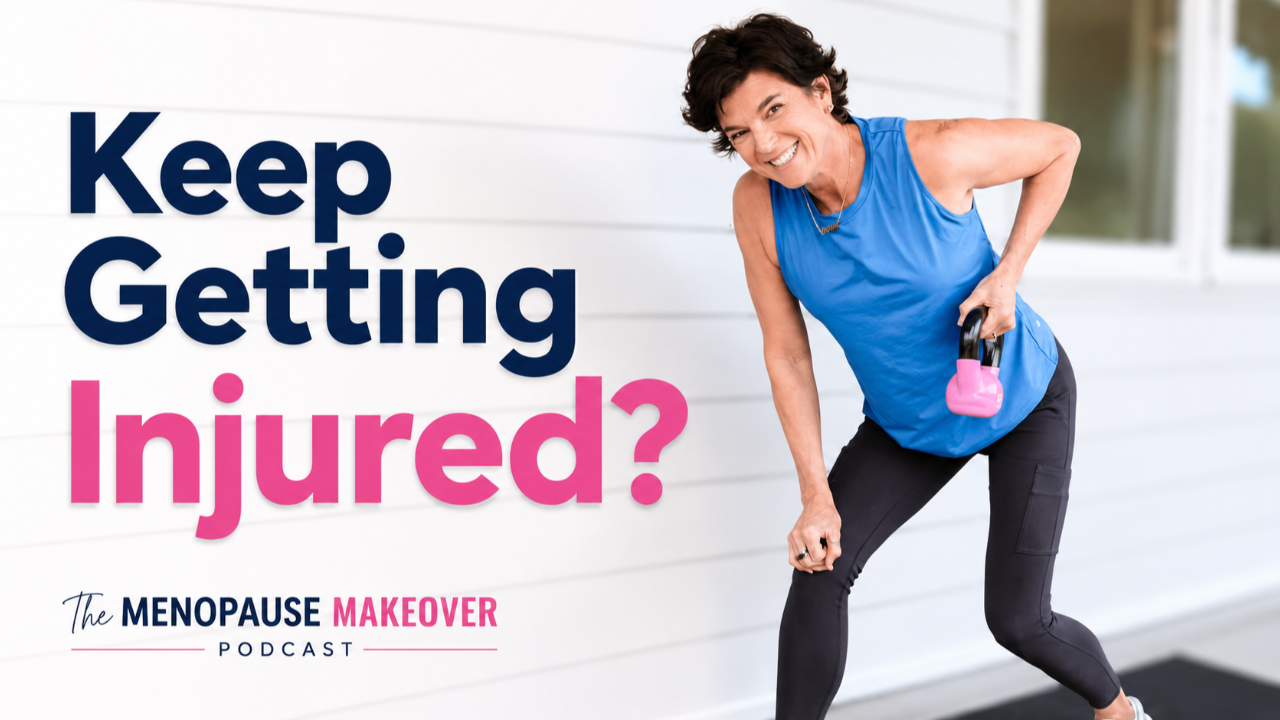
Keep Getting Injured? How to Strength Train Wisely After 40
Apple Podcast - Spotify - YouTube
Have you ever felt like every time you finally get consistent with exercise, something starts hurting?
Your knee acts up. Your shoulder gets cranky. Your back tightens. Your foot begins to ache. You finally feel like you are making progress, and then your body waves a little white flag and says, “Not so fast.”
For many women in perimenopause, menopause, and post-menopause, this can feel especially discouraging. Hormone imbalance, slower recovery, joint pain, low energy, and muscle soreness can make it harder to strength train the way you used to.
And when your goal is strength training to lose weight, reduce stubborn belly fat, and build lasting muscle, an injury can feel like one more thing standing in your way.
I understand that frustration more than I wish I did.
Over the last several years, I have dealt with gluteal tendinopathy, a tear, arthritis in my hand, tennis elbow—which I lovingly call pickleball elbow—and pelvic floor issues that eventually required surgery. There have been many moments when I could have agreed with the thought, “My body is falling apart.”
But I have learned to stop that thought before it becomes the story I tell about myself.
Your body may be asking you to adjust. It may be asking for more recovery, better mobility, additional protein, or a different way to exercise. But that does not mean your body has failed you, and it certainly does not mean you are doomed.
When an Injury Starts Becoming Your Identity
One of my clients recently said something that I know many women can relate to.
She said, “I have been chasing one injury after another, and honestly, I feel doomed. Why even start?”
I could immediately understand where she was coming from. Repeated setbacks are frustrating. It is hard to feel excited about beginning again when you are afraid something else is going to hurt.
But that last thought—“Why even start?”—was stealing her hope.
There is a difference between saying, “I am frustrated because I have dealt with several injuries,” and saying, “I am doomed, so there is no point in trying.”
One acknowledges the circumstance. The other turns the circumstance into an identity.
That is often what happens in midlife. When we are younger, we tend to see aches and injuries as temporary. We assume we will bounce back.
Somewhere along the way, though, the story can change.
A sore knee becomes evidence that you are getting old. A painful shoulder becomes proof that your body cannot handle exercise. A season of low energy starts sounding like, “I am just not an active person anymore.”
The injury becomes more than an injury. It becomes who you believe you are.
This is where we need to pause and allow the Lord to renew our thinking. Romans 12:2 reminds us that we are transformed by the renewing of our minds.
That does not mean we deny what hurts. It means we stop agreeing with thoughts that make the situation feel permanent, hopeless, or bigger than God’s ability to lead us through it.
You can be honest about your pain without declaring defeat over your future.
Hormone Imbalance Can Make Your Body Feel Louder
Our midlife bodies are talking to us, ladies, and sometimes they are much louder than they used to be.
In our 20s and 30s, we may have been able to skip sleep, ignore recovery, eat inconsistently, sit for eight hours, and then jump straight into a hard workout. That was not necessarily healthy, but our bodies often let us get away with it.
Midlife changes that.
Hormone imbalance can affect your energy, sleep, muscle recovery, inflammation, joint comfort, and ability to tolerate certain types of exercise. Workouts that once felt easy may suddenly leave you sore for several days.
This can feel alarming, especially when you are doing your best to follow Trim Healthy principles, eat well, and strength train consistently.
It may need more sleep.
It may need a longer warm-up.
It may need more mobility work.
It may need additional protein to support muscle repair.
It may need less intensity for a season.
It may need you to stop pushing through pain and start paying attention to the signals you have been ignoring.
That does not make you weak. It makes you wise.
Proverbs 4:7 tells us that wisdom is the principal thing. Wisdom does not say, “Push harder no matter what.” Wisdom asks, “What does my body need so I can continue taking care of it well?”
Your body is a gift from God. Listening to it is not giving up. It is stewardship.
Strength Training to Lose Weight Does Not Require Perfection
I used to think that way too.
The word “modify” did not sound very impressive to me. It sounded ineffective. I thought that if I lowered the intensity, changed the movement, or shortened the workout, I would not get results.
That simply is not true.
Sometimes the best thing you can do is reduce the intensity and preserve the habit.
Maybe you cannot do a hard lower-body workout this week, but you can train your upper body.
Maybe your shoulder is bothering you, but you can still walk, train your legs, or work on mobility.
Maybe you cannot do your usual strength workout, but you can complete five minutes of stretching or a gentle Pilates routine.
Maybe you need to take a walk instead of doing a high-intensity interval workout.
That is not quitting. That is adapting.
When I was dealing with pickleball elbow, there were movements I could not do. I could not lift heavy weights with that arm. I could not do push-ups. Certain types of yoga were uncomfortable.
But I could work my lower body. I could walk. I could do mobility. I could choose exercises that did not aggravate the injury.
I had to stop focusing only on what I could not do and start asking what I could still do.
That mindset helped me keep moving while I worked through the injury.
The same was true with my gluteal tendinopathy. I dealt with that pain off and on for nearly two years. I had to stop playing pickleball more than once, and I had to face the fact that continuing to play through the pain was not helping me heal.
That was difficult, but it was not permanent.
Today, I am on the other side of that season.
That is why I want you to be careful not to confuse a season with your future. Your current limitation is not automatically your permanent condition.
How to Strength Train When Your Body Hurts
If you are dealing with recurring aches, pain, or injury, there are three questions I encourage you to ask.
What Can You Still Do?
Most of us naturally focus on what we cannot do.
I cannot lift heavy right now.
I cannot go to my usual class.
I cannot do lunges.
I cannot walk as far as I used to.
That may all be true, but it is not the whole picture.
What can you still do?
Can you walk for ten minutes?
Can you stretch?
Can you do seated strength exercises?
Can you train a different part of your body?
Can you use lighter weights and a slower tempo?
Can you complete a five-minute mobility routine?
Make a list. You may be surprised by how many options are still available to you.
What Is Your Body Trying to Tell You?
Pain is information.
That does not mean you should panic every time something feels uncomfortable, but it does mean you should pay attention to patterns.
Do you need more recovery between workouts?
Do you need better shoes?
Do you need help from a physical therapist, physician, or qualified trainer?
Are you eating enough protein to support muscle repair?
Are you sleeping well?
Are you repeatedly doing movements that aggravate the same area?
Is stress keeping your body in a constant state of tension?
Hormone imbalance can be part of the picture, but it may not be the only piece. Midlife fitness requires us to look at the whole woman, not just the workout.
How Can You Keep the Habit Alive?
This question may be the most important one.
Maybe you cannot complete your full strength workout this week. What small action would help you remain connected to the woman you are becoming?
Could you walk for five minutes?
Could you stretch while your coffee brews?
Could you do a short mobility routine before bed?
Could you complete one or two exercises instead of skipping everything?
Preserving the habit is often more important than preserving the exact workout.
Consistency does not mean doing the same thing every single week no matter what. Sometimes consistency means continuing to care for your body in the way it needs today.
You Are Adapting, Not Starting Over
One of the biggest mindset struggles I see in women over 40 is the belief that any interruption means they have to start over.
An injury happens, so they stop exercising completely.
A stressful week throws off their meals, so they assume the whole month is ruined.
Fatigue hits, so they decide they are no longer capable of making progress.
But healthy women do not avoid every obstacle. They learn how to adjust when obstacles come.
You are not starting over every time you need to change your plan.
You are gathering information.
You are learning your body.
You are growing in wisdom.
You are becoming more flexible, not less committed.
This matters for weight loss, belly fat, hormone health, and muscle building because long-term results are not created through a few perfect weeks. They are created when you learn how to keep showing up through different seasons.
You do not need to prove how tough you are.
You do not need to ignore pain to prove that you are disciplined.
You do not need to punish yourself because your body needs more care than it used to.
The goal is to become healthy and strong enough to enjoy the life God has given you for decades to come.
That kind of health requires patience. It requires humility. It requires listening.
And yes, sometimes it requires help.
A coach, personal trainer, physical therapist, or medical professional may be able to help you find a better strategy that fits your specific body and your current season. There is no shame in getting support.
A blanket workout plan does not work for every woman, especially when hormone imbalance, injuries, stress, sleep, and recovery all need to be considered.
Your Midlife Body Is Not Asking You to Quit
If you have been chasing one injury after another, I want to leave you with hope.
Do not let one chapter convince you that the whole book has already been written.
You are not doomed.
You are not too old.
You are not disqualified from becoming strong.
Your body may need you to slow down, modify, recover, and change your approach. That is not failure. That is maturity.
Ask yourself, “What does my body need today?”
That question can open the door to solutions you could not see when you were only focused on what had gone wrong.
Strength train when you can. Modify when you need to. Walk, stretch, recover, and keep nourishing your body with protein and healthy Trim Healthy meals.
Keep the habit alive, even if it looks different for a season.
You are not giving up. You are learning how to care for the body God has given you with wisdom, grace, and hope.
And that is how we keep becoming fit, strong, and healthy in midlife—not perfectly, but faithfully.
Ready for more real talk, fat loss tips, and hormone support made for midlife women?
Author
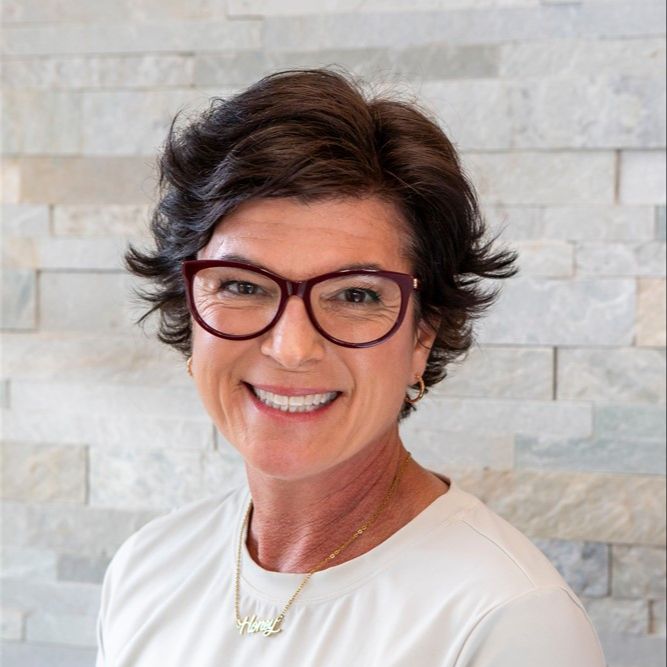
Kris Honeycutt
I’m a Trim Healthy executive coach, menopause fitness specialist, and personal trainer helping women over 40 lose stubborn weight, balance hormones, and feel confident in midlife bodies. Around here, we ditch diet drama and build real results—one wise, grace-filled step at a time.
Recent Posts

Join my Tribe today
How do you make Trim Healthy your lifestyle eating plan?
By getting community & coaching support.
Real change happens with accountability and habits. You get both inside Get Your Trim On Tribe Membership.
Get Your Trim On Store
Products that I have created to help you be successful in your Trim Healthy Mama journey.
What does Coach Kris buy from the THM store?
I am an official THM store affiliate and may earn a commission from purchases made through this link.
Baobab - Optimized Plant Protein - Optimized Whey Protein - Essential Amino Acids - No Carb Easy Bread
