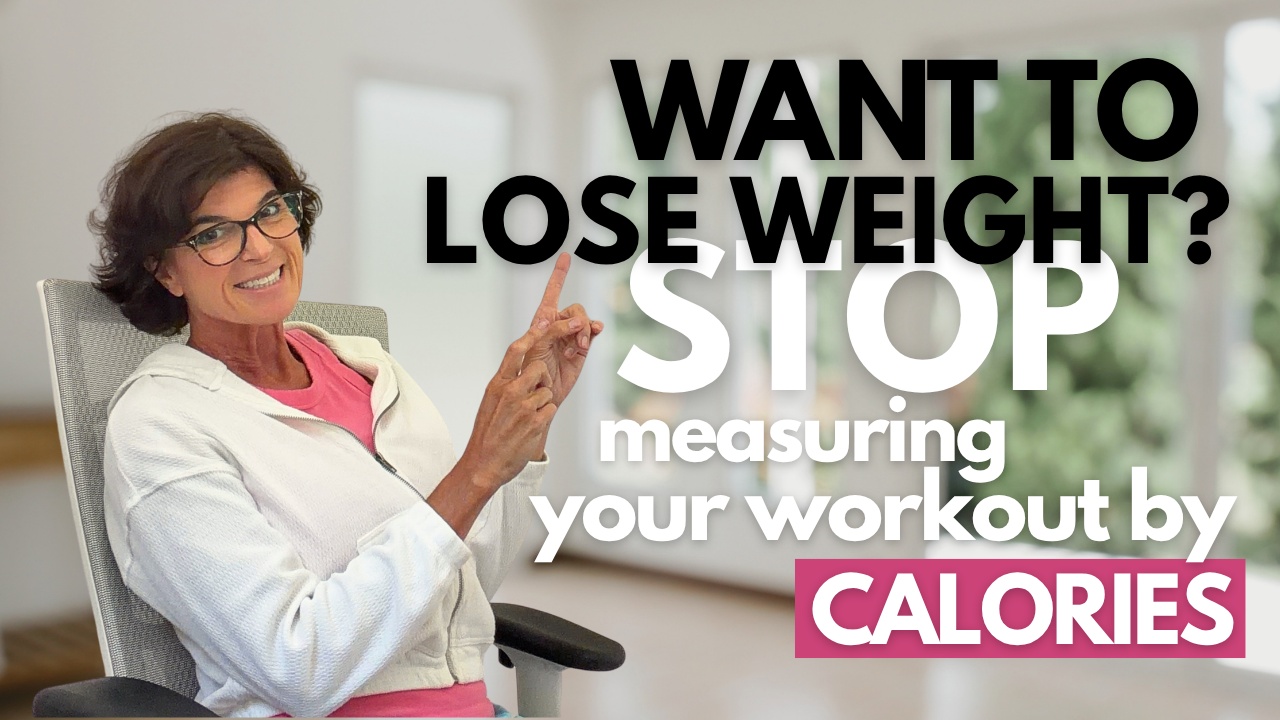
Want to Lose Weight? Stop Measuring Your Workout by Calories
Apple Podcast - Spotify - YouTube
Have you ever finished a workout drenched in sweat, looked at your watch, saw that you burned hundreds of calories and thought, Surely that had to help me lose weight? For years, women were taught that exercise for weight loss meant doing more cardio, burning more calories and eating less. But if you’re over 40 and doing all the things without seeing the changes you want, it may be time to look at strength training to lose weight in a completely different way.
That doesn’t mean cardio is bad or that walking suddenly doesn’t count. I walk, I play pickleball, and I want my ladies moving their bodies. But exercise is about much more than how many calories you can burn in 45 minutes. Strength training gives your body a reason to build and protect muscle, and that becomes incredibly important during perimenopause, menopause and the years that follow.
At this stage of life, I don’t simply want us chasing a smaller number on the scale. I want us losing fat while building a body that is strong enough to carry groceries, get up off the floor, pick up grandbabies, travel, play, serve our families and do the things God is calling us to do. And yes, I’d also like our jeans to fit better. We can want both.
Why Strength Training Matters When You Want to Lose Weight After 40
For a long time, we treated exercise like a simple math equation. Burn enough calories, eat fewer calories and eventually you arrive at the body you want. But our bodies are a lot more complex than that, especially in midlife when hormones, sleep, stress, muscle mass, food intake and recovery all influence the bigger picture.
Exercise is also a signal. When you lift something challenging, your body receives a message that it needs to become stronger. When you progressively challenge your muscles over time, your body has a reason to maintain and build muscle. Research in post-menopausal women consistently shows that resistance training can improve strength and support lean muscle mass, which is one reason it becomes so valuable as we age.
This is where I want us to change the goal a little bit. We are not just trying to lose weight. We want to lose body fat while protecting or building muscle. Those are two very different goals.
I don’t want you becoming a smaller, weaker version of yourself. I want you strong at 50, 60 and 70. I want you to have the strength and energy to live the life God has given you well. Taking care of our bodies isn’t about obsessing over them; it can be part of good stewardship. We are caring for the body we’ve been given so we can continue showing up for the people, purposes and assignments that matter to us.
Strength Training to Lose Weight Is Not About Burning More Calories
One of the biggest mindset shifts I want women to make is to stop judging a workout only by how much they sweat or how many calories their watch says they burned. Sweat isn’t the goal. Soreness isn’t the goal. Exhaustion isn’t the goal. We are looking for adaptation.
If every workout is simply about burning more, it is very easy to get caught in a frustrating cycle. You want to lose 20 pounds, so you start walking more. The scale doesn’t move quickly enough, so you add cardio. Then you eat less. Then you add another class. Before long you’re exercising five or six days a week, you’re tired, hungry, not recovering well and still staring at your belly wondering, What else am I supposed to do?
Sometimes my answer is: probably not more.
Sometimes we need to stop throwing random exercise at our bodies and give them an actual plan. That is where strength training to lose weight becomes so useful. We’re not lifting weights because a set of squats somehow melts belly fat off your waist. Unfortunately, we don’t get to choose where fat comes off first. We strength train because muscle is valuable tissue that we want to protect and build as we age.
A large analysis of 101 exercise studies involving nearly 5,700 post-menopausal women found that aerobic exercise tended to have a greater effect on fat-loss measures, while resistance training provided greater benefits for muscle. Combining the two was a viable strategy for improving overall body composition.
That’s much closer to how I want my ladies training. We aren’t choosing between walking and weights. We’re using them for different purposes.
Strength Training After 40 Requires Progression
Here’s another piece that matters. If you have been picking up the same five-pound dumbbells for the last year and doing 30 repetitions because someone told you women should “lift light to tone,” your body may not have much reason to change anymore.
At some point, the last few repetitions of an exercise should feel challenging while you are still able to maintain good form. Maybe right now you goblet squat with 15 pounds and eventually work up to 20. Maybe your Romanian deadlifts get heavier. Maybe your rows become stronger or you work toward doing more pushups. That is progression.
Progression doesn’t mean being reckless. I’m not asking you to grab the heaviest weight in the gym and prove something. We build gradually, pay attention to technique and meet your body where it is today. Then we give it somewhere to go.
This is another reason I love strength training for women over 40. You begin measuring success by more than the scale. You can notice that you are lifting heavier, moving better, feeling steadier, standing taller or doing something today that was difficult three months ago. Those wins matter.
Trying to Lose Weight? Stop Making Every Workout Hard
Another pattern I see in women who are frustrated with weight loss is that every workout becomes kind of hard. Not truly high intensity, but definitely not easy. You take a class Monday, power walk Tuesday, play pickleball Wednesday, take another class Thursday and squeeze in something else Friday because you still feel like you should be doing more.
Suddenly your entire week lives in this medium-hard zone. There is nothing inherently wrong with moderate exercise. Moderate exercise has plenty of benefits. But I like the idea of giving our bodies different training signals instead of making every workout feel basically the same.
Some sessions should be focused on strength. Some movement should be deliberately easy. And for women who are medically and physically ready for it, we can strategically add small amounts of higher-intensity work.
When I say high intensity, I do not mean punishing yourself for an hour. True high-intensity work has to be relatively short because you cannot sustain true high intensity for very long. You might use a bike, hill, rower, treadmill or another appropriate option, work very hard for a short interval and then recover.
Research suggests high-intensity interval training can improve some body-composition measures in women overall, but the findings specifically in post-menopausal women are less definitive. In other words, I’m not going to tell you that adding sprints will magically make menopause belly fat disappear.
High intensity can be one tool in a much bigger plan. More is not automatically better.
What About Jumping and Bone Health After Menopause?
You are also hearing a lot right now about women over 50 needing to jump. There are good reasons for conversations about impact exercise and bone health, but that doesn’t mean every woman needs to start doing box jumps in her living room tomorrow morning.
If you have pelvic-floor concerns, osteoporosis, fracture risk, significant joint issues, you’re newly returning to exercise or you haven’t jumped in 20 years, we need to use some wisdom. Good training progresses.
Maybe impact work eventually looks like small hops. Maybe it is jumping rope. Maybe you progress into plyometric training. For another woman, a different form of loading may be more appropriate.
There is no prize for doing the most aggressive workout. The goal is to train your body in a way that makes you stronger while respecting where you are right now.
A Simple Strength Training Plan to Lose Weight and Build Muscle
For many of the women I coach, a productive week is much simpler than what you see online. You may strength train two or three days a week, walk most days, add a small amount of intentional higher-intensity training if it is appropriate for you, and then make room for recovery.
Yes, recovery is part of the program.
I know my high-achieving ladies don’t always love that part. When we are frustrated with our weight, the natural instinct is to do something. Burn something. Cut something. Add something. We want to fix the problem immediately.
But sometimes your body doesn’t need another hard workout piled on top of an already stressful life.
I’ve been a personal trainer for decades, and even I have had to change the way I think about exercise as I’ve gotten older. I don’t approach my body exactly the way I did in my 30s, and frankly, I don’t want to. I have plenty going on in my life, and I’m not interested in spending endless hours exercising just so I can say I worked hard.
Now I ask better questions. Is this helping me build muscle? Am I getting stronger? Is this improving my conditioning or mobility? Can I recover from it? Does it fit with everything else going on in my life this week?
Those questions matter because exercise never happens in a vacuum. If you barely slept last night, you are under tremendous stress, you aren’t eating enough and you are already exhausted, the wisest choice may not be an all-out workout just because Instagram told women over 40 that they need sprints.
Wisdom matters. Learning to pay attention to your body matters too.
Strength Training and Nutrition Work Together to Help You Lose Weight
I know why many of you clicked on this article. You want the belly fat gone. You want your clothes to fit better. You want to look in the mirror and recognize yourself again.
Exercise matters, but it is not the only piece. Nutrition matters. Protein matters. Your overall energy intake matters. Hormonal changes can influence appetite, sleep, fat distribution, recovery and how you feel during this season.
This is where I appreciate the simplicity of Trim Healthy principles. We can nourish our bodies with protein, plants and the appropriate fuels without constantly turning food into something we have to earn or burn off. We can build meals that support stable energy, muscle and fat loss while still enjoying food and living a real life.
And please hear me on this one: I do not want you using exercise as punishment for eating.
You do not have to earn your dinner. You do not have to run off your breakfast. You are not exercising because you were “bad” at lunch.
We’re building a body. We’re building muscle, strength, capacity and resilience. When we combine appropriate exercise with nutrition and lifestyle habits that support fat loss, we give the body a much better environment for body-composition changes over time.
How to Know If Your Strength Training Is Actually Working
This week, I want you to look at your exercise plan with curiosity instead of judgment. Ask yourself whether you are genuinely strength training or mostly doing cardio while holding weights. Are you progressing and becoming stronger, or have you been doing the exact same thing for months?
Also ask whether every workout leaves you exhausted. Do you have genuinely easy movement in your week? Are you recovering between workouts? Are you exercising because the movement supports the body you want to build, or because you are trying to burn off something you ate?
If you have been working harder and harder while becoming more and more frustrated, I don’t necessarily want you doing more next week. I want you doing things with purpose.
Lift. Walk. Add appropriate intensity. Recover. Eat enough protein to support the muscle you are asking your body to build. Then repeat those habits long enough to give your body time to respond.
There is patience involved in this process. I know we don’t always love that. But we are playing a longer game now.
At this stage of life, our goal isn’t just to lose weight. We want to lose fat, build muscle, get strong, have energy and create a body that can carry us well through the next several decades. We want to steward our strength so that we have the capacity to keep doing the work, serving the people and enjoying the life God has placed in front of us.
That is an exercise plan worth showing up for.
And if you’re tired of trying to put all of these pieces together by yourself, come join me inside the Belly Fat Breakthrough Tribe. Inside the Tribe, I help women over 40 simplify their nutrition, follow intentional strength and movement plans, and get the coaching and support they need to stop guessing.
If you’re ready to work on that stubborn belly fat while building lasting muscle and getting stronger for the years ahead, I’d love to have you with us.
Ready for more real talk, fat loss tips, and hormone support made for midlife women?
Author
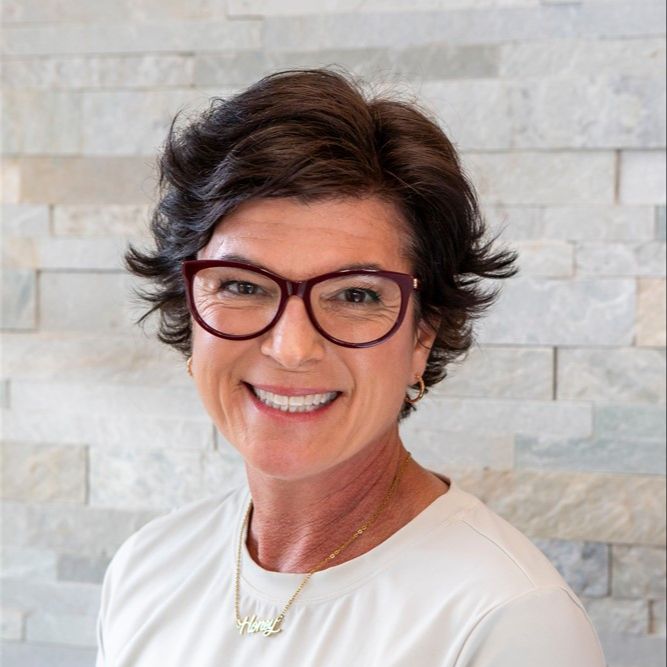
Kris Honeycutt
I’m a Trim Healthy executive coach, menopause fitness specialist, and personal trainer helping women over 40 lose stubborn weight, balance hormones, and feel confident in midlife bodies. Around here, we ditch diet drama and build real results—one wise, grace-filled step at a time.
Recent Posts

Join my Tribe today
How do you make Trim Healthy your lifestyle eating plan?
By getting community & coaching support.
Real change happens with accountability and habits. You get both inside Get Your Trim On Tribe Membership.
Get Your Trim On Store
Products that I have created to help you be successful in your Trim Healthy Mama journey.
What does Coach Kris buy from the THM store?
I am an official THM store affiliate and may earn a commission from purchases made through this link.
Baobab - Optimized Plant Protein - Optimized Whey Protein - Essential Amino Acids - No Carb Easy Bread
