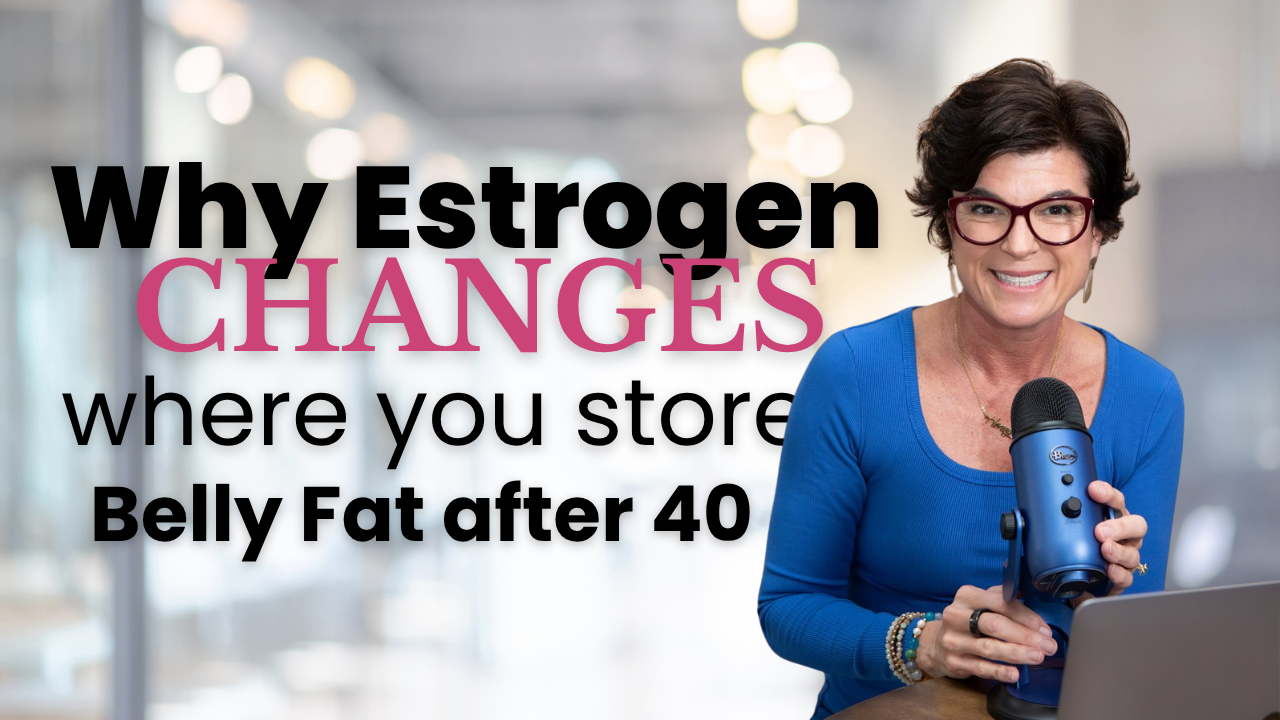
Why Estrogen Changes Where You Store Belly Fat After 40
Apple Podcast - Spotify - YouTube
Have you ever looked at your stomach and thought, “Wait a minute. I haven’t even gained that much weight. Why does my body look so different?” Maybe the scale is only up five pounds—or maybe it hasn’t changed much at all—but your jeans are tighter around the waist and you’re noticing more softness through your middle.
If you’re in your 40s, 50s or beyond, there is a very real reason this can happen. One of the big players is estrogen.
As estrogen begins fluctuating during perimenopause and eventually settles at a lower level after menopause, we can see changes in body composition and where our bodies prefer to store fat. That means belly fat after 40 isn’t always as simple as, “Well, I must be eating too much.”
Understanding this doesn’t mean we blame everything on our hormones and throw our hands in the air. It means we learn what’s happening so we can stop throwing random solutions at our bodies and start using strategies that actually make sense for this season of life.
Why Belly Fat After 40 Can Show Up Without Major Weight Gain
This happened to me. My weight went up a little, but the bigger change was what happened to my body shape. I got to the point where I literally had to get rid of pants, shorts and jeans because my body was storing more fat through my abdomen.
The scale wasn’t telling the whole story.
And I hear this from women all the time: “Kris, I haven’t gained THAT much weight. Why does my stomach look so different?” The reason is that weight and body composition are not the same thing.
You can have two women who weigh exactly the same amount and have very different amounts of muscle and body fat. You can even weigh approximately what YOU weighed several years ago and still notice a very different shape.
That’s why I don’t want you using the scale as your only measurement of progress.
What Estrogen Has to Do With Belly Fat
We usually think about estrogen in terms of periods, pregnancy, hot flashes and menopause, but estrogen does a whole lot more. Estrogen receptors are found throughout the body, and estrogen is involved in bone health, cardiovascular health, brain function, metabolism and body composition.
During perimenopause, estrogen doesn’t simply shut off one day. Instead, it can fluctuate. There may be times when estrogen is relatively high and other times when it drops. Ovulation becomes less predictable, progesterone changes too, and the whole hormonal environment can feel a little chaotic.
Hello, perimenopause.
After menopause, estrogen settles at a much lower level than it was during our reproductive years. Research has associated the menopause transition with a shift toward greater abdominal and visceral fat storage. Visceral fat is the deeper abdominal fat stored around our organs.
Hormone Imbalance Isn’t the Whole Story
This is where I want us to be careful. I don’t want you reading this and thinking, “My estrogen dropped. That’s it. I’m doomed to have belly fat.”
Menopause doesn’t happen in a vacuum. At the same time estrogen is changing, we’re also aging and becoming more vulnerable to losing muscle. Our activity levels may change, sleep can become disrupted, stress may increase, and insulin sensitivity can change.
We’re dealing with a whole hormonal orchestra here, not one hormone standing on stage playing a solo.
That’s why simply blaming hormone imbalance isn’t very helpful. What IS helpful is understanding what you can actually do with this information—and one of the biggest places I want you to start is with muscle.
Want to Lose Belly Fat After 40? Build Muscle
Muscle becomes increasingly important as we move through midlife. If we’re losing muscle while simultaneously becoming more likely to store fat around the abdomen, our bodies can change dramatically even without a huge change on the scale.
You may weigh the same but have less muscle and more body fat. That is a very different body composition, and it’s one reason I don’t want you chasing weight loss at any cost.
If you lose ten pounds but a significant portion of that is precious muscle, I don’t consider that a great trade. I want you losing fat while maintaining—and hopefully building—muscle.
Because muscle isn't just about looking toned.
Muscle plays an important role in glucose disposal and insulin sensitivity. It also helps protect our bones, maintain our independence and keep us doing the things we love—carrying groceries, getting up off the floor, picking up our grandchildren, traveling, gardening or playing pickleball.
We’re building bodies we want to LIVE in.
Strength Training After 40 Is One of Your Best Tools
If you’re not strength training right now, start—but that does not mean you need to walk into a gym tomorrow and throw a giant barbell over your head. Start where you are.
For many women, two full-body strength workouts per week can be a fantastic beginning. Learn the basic movement patterns like squatting, hinging, pushing, pulling and carrying, and use enough resistance that your muscles actually have a reason to adapt.
Eventually, you also need to progressively challenge yourself. Doing the same five-pound dumbbell workout for the next ten years isn’t the goal.
We want to give your body a reason to say, “Hey, apparently we need this muscle. Let’s keep it.”
Can You Lose Weight With High Protein After 40?
Protein goes hand in hand with strength training. I generally want my ladies thinking about getting a solid protein anchor at their meals. For many women I coach, we’re looking at roughly 25–30 grams of protein at a meal, sometimes more depending on the woman and her individual needs.
This is one reason I’m such a big fan of simplifying your meals around Protein + Plants + Power. Start with your protein, add beautiful plants, and then add the appropriate Trim Healthy fuel for your meal—healthy carbohydrates, healthy fats or occasionally both in a Crossover.
If you're trying to lose weight with high protein, remember that protein isn’t some magical belly-fat eraser. But it is an important part of preserving and building muscle and creating meals that actually satisfy you.
I would much rather see you start your morning with a solid protein-centered meal than survive on coffee and half a piece of toast until you find yourself standing in the pantry at 4 p.m. wondering why everything suddenly looks delicious.
You Don’t Have to Give Up Carbs to Lose Belly Fat
Please hear me on this one: entering menopause does not mean carbohydrates suddenly became bad.
If you’ve followed Trim Healthy Mama for any length of time, you already know I’m a fan of beautiful, healthy carbohydrate foods. Oats, beans, lentils, fruit, sweet potatoes and brown rice bring more than carbohydrates to the table. They also provide fiber, vitamins, minerals and phytonutrients.
Your body’s response to carbohydrates may change as you age, especially if insulin sensitivity changes. But the answer isn’t automatically, “No more carbs!”
Instead, we can use carbohydrates strategically. Pair them with protein, choose good sources, pay attention to portions and fuel balance, and learn how YOUR individual body responds.
That is very different from declaring war on an entire macronutrient because you turned 50.
Walking and Daily Movement Matter Too
Your workout matters, but so does everything you do during the other hours of your day. Walk, take the stairs, get up from your desk, take a ten-minute walk after dinner, do an exercise snack, garden or play with your grandkids.
Those little bits of movement add up, and movement after meals can be particularly helpful for glucose management. But please don’t turn this into another giant item on your to-do list.
Five minutes counts. Ten minutes counts. It all counts.
Sleep, Stress and Hormone Imbalance Are Connected
We can’t have a conversation about menopause without talking about sleep. Estrogen changes, hot flashes show up, night sweats wake you up, and suddenly you’re exhausted the next day.
Maybe you skip your workout because you’re tired. You’re hungrier, you crave quick energy, your patience is lower, and by 3 p.m. you’re reaching for another coffee just to keep going.
Of course making healthy choices feels harder.
That’s physiology meeting real life, and it’s why I don’t want you reducing midlife fat loss to one simple equation. Food matters, movement matters, muscle matters, sleep matters, stress matters, hormones matter—and consistency matters.
Don’t Chase Estrogen—Change Your Midlife Strategy
If there’s one thing I want you to take away from this, it’s this: don’t chase estrogen.
If you're experiencing significant symptoms such as hot flashes, sleep disruption, vaginal or urinary symptoms, mood changes, abnormal bleeding or other changes that concern you, talk with a qualified healthcare practitioner who understands menopause and hormones. Hormone therapy can be appropriate for some women, and that is an individual conversation to have with your healthcare provider. Hormone therapy itself is not a weight-loss treatment.
What I want you to understand is that your hormonal environment has changed. So instead of pushing your body harder because it isn’t responding like it did at 30, let’s change the strategy.
And above all, remember that God gave you this body to steward—not spend the next 30 years fighting.
Your body at 50 or 60 isn’t supposed to be identical to your body at 30. That doesn’t mean we stop pursuing health or shrug our shoulders at changes we can influence. We take care of the body we have today with wisdom, patience and consistency.
I’m not trying to get you back into your 30-year-old body.
I want to help you build an incredibly strong, healthy 50-, 60- and 70-year-old body.
And friend, that is a goal worth pursuing.
Ready to Get Rid of Stubborn Belly Fat?
If you’re tired of trying to piece all of this together by yourself—your Trim Healthy meals, protein, strength training, hormones, movement and consistency—I’d love to help you.
Inside my Belly Fat Breakthrough Tribe, I help women over 40 stop guessing and start putting these strategies into practice in real life. We’re building muscle, eating beautiful food, learning how to work WITH our changing bodies and creating habits we can actually keep.
If you’re ready to get fit, get strong and make progress on that stubborn belly fat, come join us inside the Belly Fat Breakthrough Tribe.
Ready for more real talk, fat loss tips, and hormone support made for midlife women?
Author
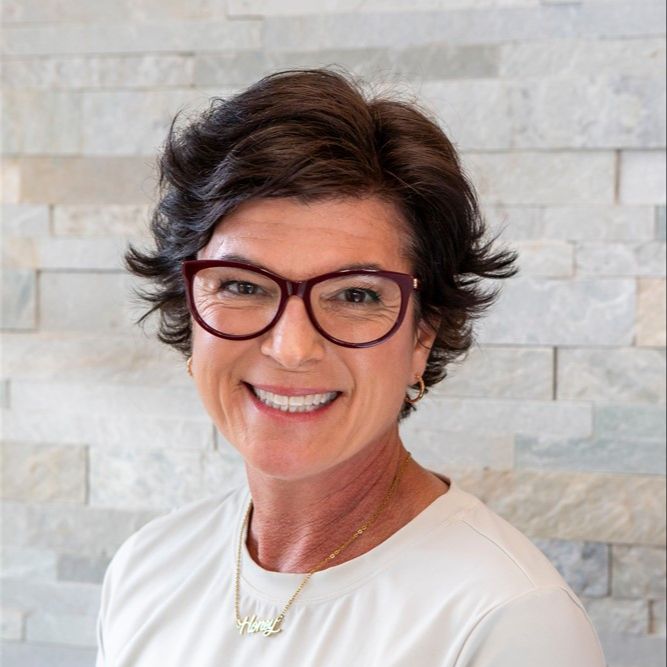
Kris Honeycutt
I’m a Trim Healthy executive coach, menopause fitness specialist, and personal trainer helping women over 40 lose stubborn weight, balance hormones, and feel confident in midlife bodies. Around here, we ditch diet drama and build real results—one wise, grace-filled step at a time.
Recent Posts

Join my Tribe today
How do you make Trim Healthy your lifestyle eating plan?
By getting community & coaching support.
Real change happens with accountability and habits. You get both inside Get Your Trim On Tribe Membership.
Get Your Trim On Store
Products that I have created to help you be successful in your Trim Healthy Mama journey.
What does Coach Kris buy from the THM store?
I am an official THM store affiliate and may earn a commission from purchases made through this link.
Baobab - Optimized Plant Protein - Optimized Whey Protein - Essential Amino Acids - No Carb Easy Bread
